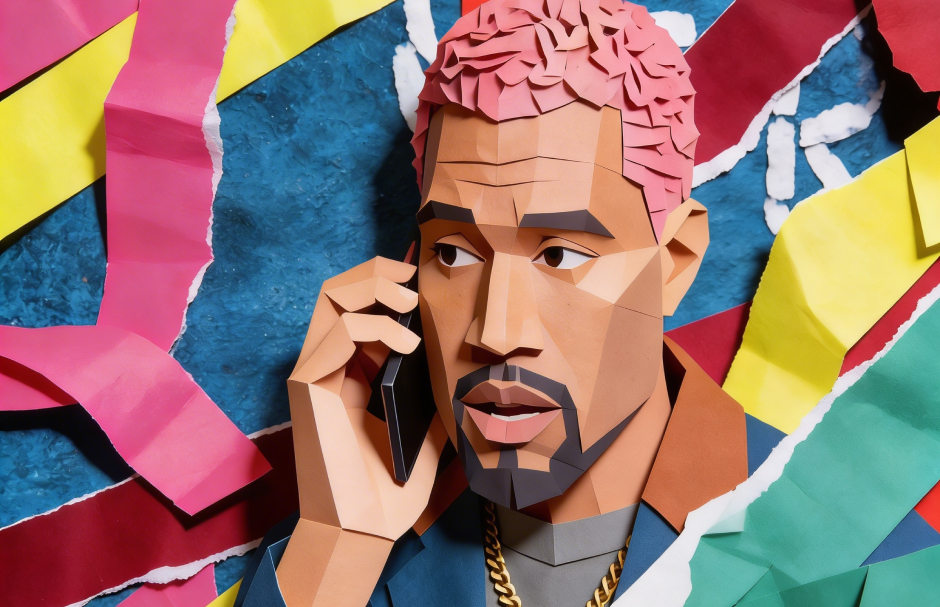
Ye released Bully on Saturday morning without much warning and without much explanation. That’s intentional. The 18-track album, clocking in at 42 minutes, dropped just ahead of two SoFi Stadium shows in Los Angeles on April 1 and 3 — and it arrived the same way Ye has always arrived when he’s operating at his most interesting: quietly, then all at once.
The music video for “Father” — featuring Travis Scott on his verse and directed by Bianca Censori — is the clearest window into what this era is about. And if you watch it closely, it’s saying a lot more than Ye is willing to say out loud.
What’s Actually Happening in the ‘Father’ Video
The video is a single-camera scene set inside a sparse church. Minimalist in design, maximalist in what’s going on inside it. A man’s card tricks turn to flames. Nobody looks up. A knitting grandmother sits in a pew, unbothered. A plate-armored knight on horseback leads a police squad down the center aisle to arrest a sleeping nun. A Michael Jackson lookalike sits quietly in the back row, alone. A UFO lands. Still, nobody flinches.
Ye and Travis Scott eventually pull down masks revealing alien faces — the implication being that they were never fully human in the first place, or at least that’s what celebrity does to a person.
The whole thing plays out like a fever dream of modern absurdity, and the congregation just keeps sitting there. That’s the point. The video isn’t weird for the sake of weird. It’s a fairly direct commentary on how much we’ve collectively agreed to ignore — spectacle, chaos, authority overreach, surrealism — as long as it happens inside a familiar enough container. The church setting isn’t subtle. Neither is the indifference.
Ye hasn’t explained any of it. He doesn’t need to.
The Album
Bully is 18 songs, 42 minutes, and remarkably focused for a Ye project. The tracklist includes Don Toliver on “Circles,” Peso Pluma on “Last Breath,” CeeLo Green on the title track “Bully,” and Ye’s music director Andre Troutman appearing on both “All the Love” and “White Lines.” Travis Scott’s appearance on “Father” is the most high-profile feature, and the video attached to it suggests it’s the artistic centerpiece of the rollout, even if Ye hasn’t positioned it that way explicitly.
The sound, the length, and the sequencing all suggest an artist who made deliberate choices — which is worth noting given where Ye has been over the last several years. This isn’t a sprawling, unfinished-feeling project. It’s tight, which is either a sign of creative clarity or a sign of someone who has learned, finally, that less can do more.
The Context Nobody Can Ignore
Bully is Ye’s first album release since the antisemitic remarks and erratic public behavior that dominated headlines from 2022 through 2024, cost him partnerships with Adidas, Gap, and others, and triggered a period of sustained public fallout that few artists have experienced at that scale.
In January, Ye took out a full-page apology ad in the Wall Street Journal. The statement was more substantial than most public apologies tend to be — specific about the diagnosis, specific about the behavior, and specific about the accountability. He attributed his conduct directly to his bipolar type-1 diagnosis and an undiagnosed brain injury from a car crash 25 years ago. “One of the difficult aspects of having bipolar type-1 are the disconnected moments — many of which I still cannot recall — that led to poor judgment and reckless behavior that oftentimes feels like an out-of-body-experience,” he wrote. “I regret and am deeply mortified by my actions in that state, and am committed to accountability, treatment and meaningful change. It does not excuse what I did, though.”
That last line is doing a lot of work. It’s the difference between an explanation and an excuse, and Ye drew that line himself.
Whether you take that statement at face value is a personal call. What’s harder to argue with is the music. The chorus of “Father” goes: “Bye-bye to my old self / Wake up to the new me / I used to be on Worldstar / Now I’m making Newsweek / I used to hang on the 9 / Now I bought two streets / Cottage Grove to King Drive / Yeah, this life is a movie.” It reads like a man taking stock of distance traveled — geographic, financial, psychological — and trying to locate himself in the gap between who he was and who he’s become.
That’s a more honest framing than most artists offer in a comeback moment. Usually it’s deflection or rebranding. This feels more like reckoning, even if it’s a reckoning delivered in Ye’s typically oblique, image-first language.
It’s also worth noting that the legal side of Ye’s story is still active. Earlier this year, a federal judge dismissed the majority of copyright claims tied to his Donda album, ruling that the plaintiffs never obtained a valid written transfer of the disputed composition. A narrower dispute over early demo versions of “Hurricane” is still headed to trial. The comeback and the courtroom are running on parallel tracks.
What This Moment Actually Is
The SoFi Stadium shows will tell us something. Two nights in Los Angeles, one of the markets where the fallout was most visible and most personal — the city where he built his brand, his relationships, and his legacy, and also where a lot of it came apart. Selling out those shows, or not, will say more about where the public actually is than any op-ed or streaming number can.
Bully isn’t a redemption album in the traditional sense. Ye doesn’t make those. It’s something closer to a resumption — an artist stepping back into the frame and saying, without saying it directly, that he’s still here, still working, and still operating at a level most people aren’t.
Whether the industry and the audience are ready to receive that is a separate question. But the music made the case before anyone had a chance to debate it. That’s always been Ye’s move. It still works.